– Elongation: Meaning tenacity of the material. The greater the elongation, the greater the toughness.
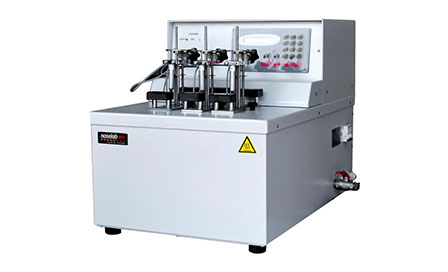
– Distortion at temperature (HDT): Generally the HDT reflects the resistance of resins to temperature.
– Tg: Glass transition temperature. Its value is normally 5 to 10 ºC higher than the HDT. If this is reached, the structure of the resin changes. There is no going back.
– Volume Shrinkage: Reflecting the dimensional behavior of the material after curing.
– The higher the crossover density, the higher the distortion temperature (HDT) and conversely, the lower the toughness.
– The higher the crosslink density, the higher the hardness of the material.
– The higher the crosslinking density, the lower the tensile and flexural strengths.
– The tensile strength will decrease, while its tensile modulus will increase.
– The rigidity of the material will increase.
OI (Oxygen Index) : A parameter that judges the flame retardancy of a material. The higher the O.I., the better the behavior to the flame will be.
– Coefficient of Linear Expansion: The reaction characteristics of a material change with heat. The more similar the coefficients of linear expansion of two materials are, the more similar their HDT will be and the better the bonding of both will be.
– The physical properties of resins vary between a wide range of values, depending on the type of resin used, the nature and proportion of the reinforcement, the curing conditions and the molding techniques used, without forgetting the type of monomer and the influence of the use of catalysts and accelerators on the curing time.
– From all this we can deduce the importance of knowing how to choose the right resin (Orthophthalic, Isophthalic, Vinylester, Epoxy, etc.) depending on the use of the part and applying the appropriate catalytic systems.