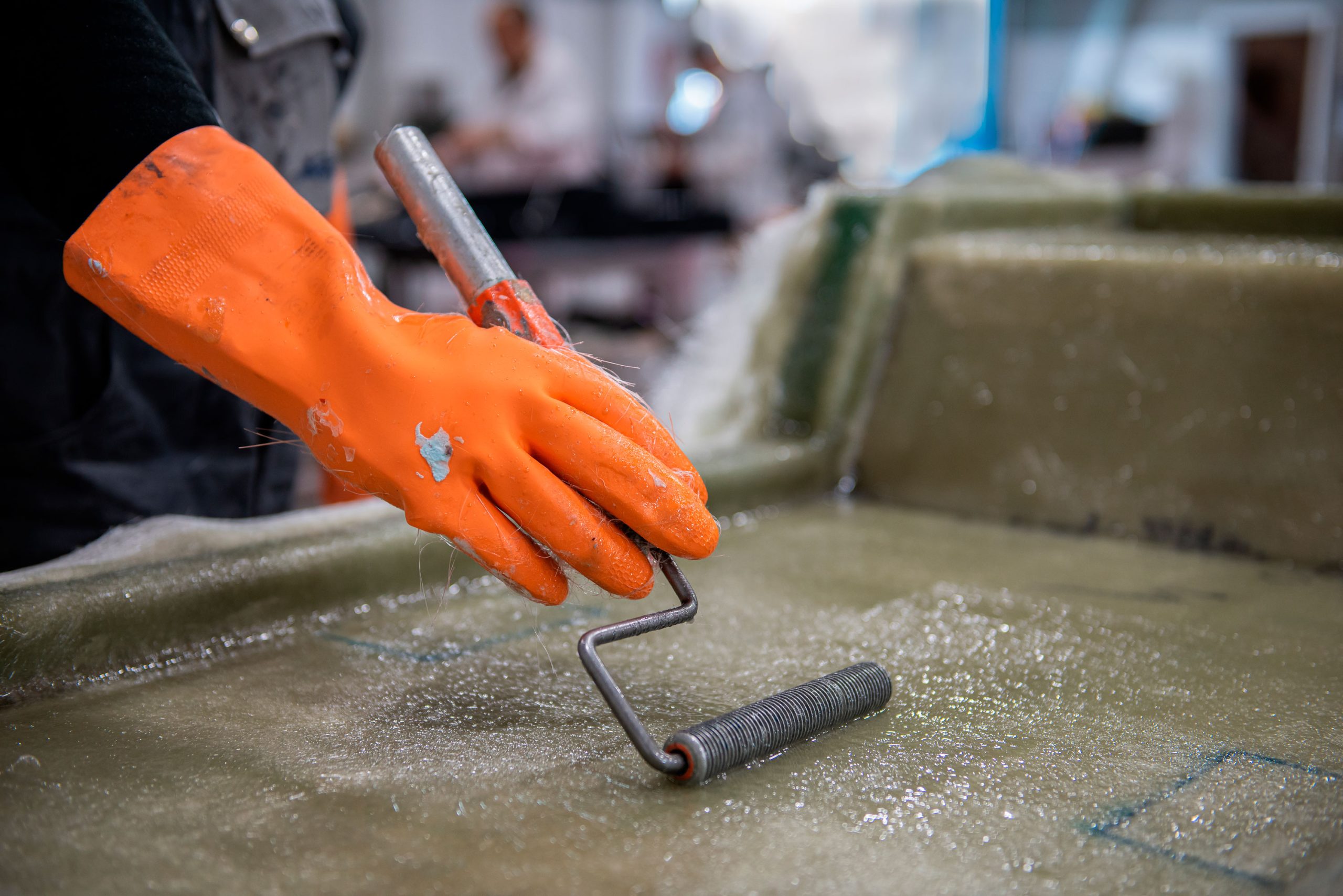
In the manufacture of composite materials, the manual process requires the direct intervention of operators. The choice of technique has a direct impact on the final result. How? Read on.
The importance of the various techniques, tools and applications in the manufacture of composite materials lies in their ability to offer solutions adapted to different needs within the sector.
Manual techniques allow greater flexibility and control in the production of customised and complex parts, yet it is easier to see the details. Automated application, such as that used in the projection process, is more efficient in large-scale production.
The application of each process not only influences the final result, the various techniques and tools play an important role in meeting the needs of projects and meeting the challenges in the production of composite materials.
Manual processing and its impact on composite materials
At Global Composites we are committed to innovation and sustainability, and we do so by exploring in depth the most current techniques and tools to carry out processes such as manual and screening in the manufacture of composites, in a way that is more in line with the development goals envisaged in the 2030 Agenda. We start by defining the types of processes and their main characteristics.
What is a manual process?
Manual processing refers to the use of manual skills and techniques by operators to create composite products. In this type of manual technique, workers perform tasks such as applying resins, arranging reinforcements such as glass or carbon fibres, and shaping parts using tools and moulds.
Its main feature is that operators have more direct control over the process, which can be beneficial in situations where greater attention to detail or customisation is required.
✅ Advantages of the manual process
- Flexibility: allows adaptation to specific requirements.
- Precise control: management of each stage of the process, facilitating attention to detail.
- Adaptability: easily adjusts to changes in design or production.
❌ Disadvantages of the manual process
- Time: Generally slower than other processes.
- Variability: manual intervention can change the intended outcome.
- Cost: labour is required, which increases production costs.